
Close your eyes and picture Antarctica. You almost certainly imagine a landscape of pristine, blinding white: endless fields of powdery snow, colossal blue-tinted icebergs drifting in freezing seas, and towering glaciers frozen in absolute stillness under a pale polar sky.
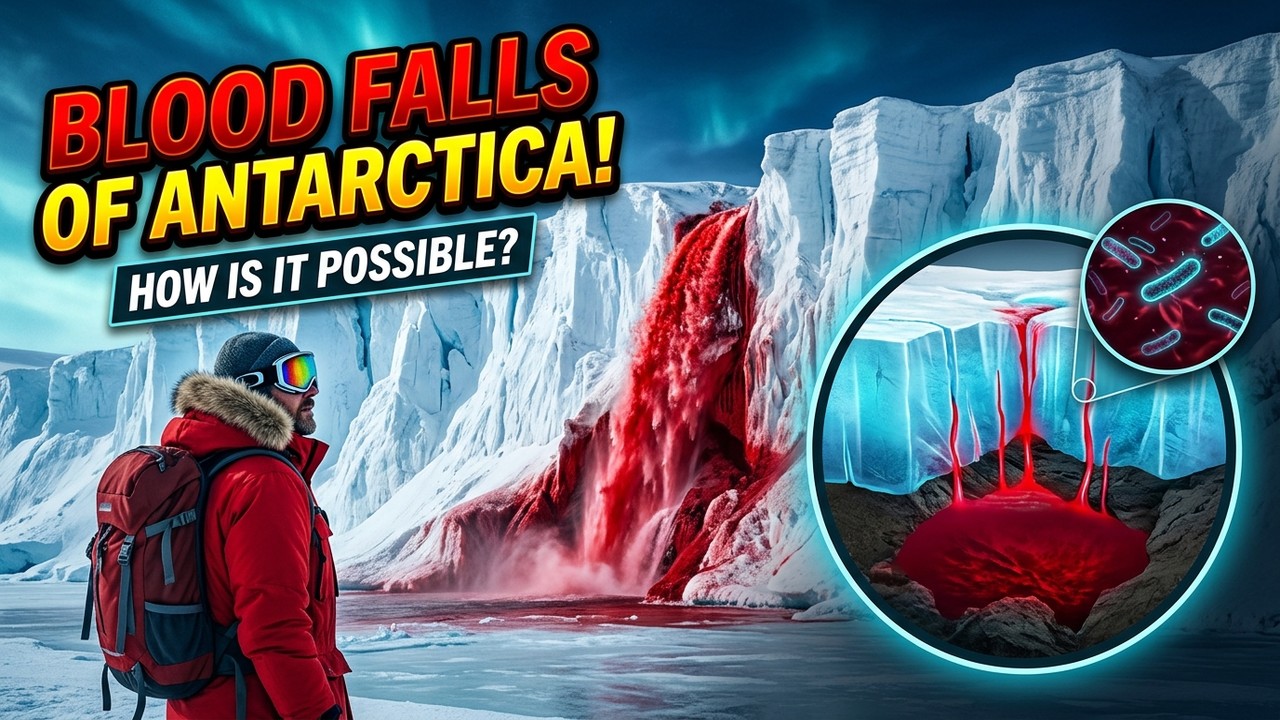
Now, imagine walking across this frozen desert and coming face-to-face with a scene that looks like something out of a chilling fantasy novel: from a narrow fissure carved high into the sheer wall of a snow-white glacier, a torrent of vivid, deep crimson liquid pours downward, staining the ice like an open, bleeding wound before spilling across the frozen surface of a lake below.
You check your weather instruments: the air temperature is a bone-chilling $-17^\circ ext{C}$ ($1^\circ ext{F}$). Under normal physical laws, freshwater freezes solid into ice at $0^\circ ext{C}$. Any ordinary stream of water flowing outdoors in this climate should freeze instantly into a block of solid ice within seconds.
Yet, this liquid flows freely. And it is blood-red.
Blood Falls of Antarctica: The Secret Beneath Taylor Glacier
Our academic video documentary exploring how a 2-million-year-old trapped marine fjord, iron oxidation chemistry, and subglacial extremophiles create Antarctica's blood-red waterfall will premiere right here.
This astonishing natural wonder is known to the scientific community as Blood Falls. Located in one of the most remote and hostile corners of our planet, this five-story-tall crimson waterfall has puzzled geologists, chemists, and biologists for more than 110 years.
In this comprehensive masterclass designed specifically for young scholars of Classes 9 and 10 preparing for the National Geography Talent Search Exam 2026, the Academic Editorial Board of Mission Geography takes you beneath the Antarctic ice sheet. We will unravel the chemical reactions, thermodynamics, ancient geography, and shocking biological discoveries that make Blood Falls one of the greatest scientific laboratories on planet Earth.
1. The 1911 Discovery: A Blood-Stained Glacier in the Heroic Age
The story of Blood Falls begins in 1911 during the golden age of polar exploration. British explorer Captain Robert Falcon Scott led his famed Terra Nova Expedition toward the South Pole. Accompanying Scott was a brilliant Australian geologist and physiographer named Thomas Griffith Taylor.
While exploring the bizarre ice-free valleys of Victoria Land in East Antarctica, Taylor stumbled upon an unforgettable sight: a brilliant white tongue of ice pouring down from the continental ice plateau, marked by an enormous splash of dark red staining the ice cliff for several hundred meters. Taylor was stunned. The glacier was eventually named Taylor Glacier in his honor, and the crimson feature was dubbed Blood Falls.
Taylor originally hypothesized that the red color was caused by microscopic colonies of red algae (similar to Chlamydomonas nivalis, which creates the pink "watermelon snow" occasionally observed on alpine glaciers). However, when early samples were brought back to civilization and examined under microscopes, scientists found no photosynthetic algae cells or plant pigments whatsoever. The crimson color was completely inorganic—the result of a geochemical mystery buried deep beneath the ice.
2. The Bizarre Geography of the McMurdo Dry Valleys
To understand why Blood Falls exists, we must first examine its geographical address: the McMurdo Dry Valleys. This is one of the strangest and most extreme geological environments on Earth.
Antarctica is covered by a colossal continental ice sheet holding approximately 70% of the world's freshwater. Yet, occupying an area of roughly 4,800 square kilometers within Victoria Land are the Dry Valleys—a collection of deep, ice-free valleys bounded by the Transantarctic Mountains.
The Coldest and Driest Desert on Earth
Why are the Dry Valleys free of snow and ice? First, the towering Transantarctic Mountains block moisture-rich storms rolling in from the Ross Sea. Second, fierce gravity-driven winds called katabatic winds sweep down from the high polar plateau, accelerating through the valleys at speeds exceeding 320 km/h (200 mph). These bone-dry winds heat adiabatically as they descend, sublimating and evaporating every single flake of snow before it can accumulate. The McMurdo Dry Valleys have not seen rain in nearly 2 million years!
At the floor of the Taylor Valley sits Lake Bonney, a perennially frozen lake covered by a permanent 3-to-4-meter crust of solid ice. Terminating directly at the western edge of Lake Bonney is the snout of Taylor Glacier—and right at this contact point, Blood Falls makes its dramatic appearance.
3. Mystery #1: Why Doesn’t the Water Freeze in Sub-Zero Cold?
The most immediate paradox of Blood Falls is physical: the average temperature inside Taylor Glacier is $-17^\circ ext{C}$, and winter air temperatures plunge past $-40^\circ ext{C}$. How can liquid water flow under conditions where exposed freshwater freezes solid almost instantly?
The solution lies in the physical chemistry of solutions, specifically a fundamental colligative property known as Freezing Point Depression.
A. The Power of Hypersaline Brine
The water feeding Blood Falls is not freshwater; it is an ultra-dense, concentrated hypersaline brine. Chemical analyses reveal that the brine has a salinity between 8% and 10% (80 to 100 parts per thousand)—making it nearly three times saltier than the average global ocean (which averages 3.5% or 35 ppt)!
When salt (primarily sodium chloride, along with magnesium, calcium, and sulfate ions) dissolves in water, the charged ions ($Na^+$ and $Cl^-$) interact strongly with the polar water molecules ($H_2O$). These ions physically disrupt the geometric lattice required for water molecules to freeze into solid hexagonal ice crystals. Under Raoult's law and the colligative freezing depression formula:
$$\Delta T_f = i \cdot K_f \cdot m$$Where $i$ is the van 't Hoff factor, $K_f$ is the cryoscopic constant of water ($1.86^\circ ext{C}\cdot ext{kg/mol}$), and $m$ is the molality of dissolved solutes. Because of its extreme salinity, the freezing point of the Blood Falls brine is depressed down to approximately $-7^\circ ext{C}$ to $-10^\circ ext{C}$!
B. The Latent Heat Engine Inside the Glacier
Even with its low freezing point, $-7^\circ ext{C}$ is still warmer than the $-17^\circ ext{C}$ interior of Taylor Glacier. Why doesn't the brine eventually freeze solid anyway? In 2017, a landmark study led by geophysicist Dr. Erin Pettit (University of Alaska Fairbanks) used radio-echo sounding (radar) to map the plumbing system inside Taylor Glacier. They uncovered a fascinating thermodynamic mechanism:
Latent Heat of Freezing: The Self-Warming Glacial Pump
When salty water freezes, it expels the salt ions, forming pure freshwater ice while leaving the remaining unfrozen liquid even saltier. As water molecules transition from liquid to solid ice, they release tremendous thermal energy known as the Latent Heat of Freezing ($334 ext{ kJ/kg}$).
Inside Taylor Glacier, the partial freezing of water along the edges of the subglacial channels actually releases heat directly into the surrounding brine! Combined with geothermal heat rising from the Earth's mantle and the immense pressure exerted by 400 meters of overlying glacier ice, this latent heat keeps the subglacial plumbing system warm enough for liquid brine to remain fluid and carve pressurized pathways all the way to the glacier's face!
4. Mystery #2: Why Is the Water Blood-Red?
If you were to drill a borehole through the 400-meter-thick ice of Taylor Glacier and sample the brine directly from the subterranean reservoir, you would witness a baffling surprise: the water inside the subglacial lake is completely clear and colorless!
How does crystal-clear water transform into an opaque, blood-red river the moment it emerges from the ice? The answer is a dramatic chemical reaction driven by one of the most common elements in Earth's crust: Iron.
A. The Iron-Rich Subglacial Reactor
The bedrock beneath Taylor Glacier is rich in ferromagnesian igneous rocks (such as Ferrar dolerite and basalt). As the heavy glacier slowly grinds against the bedrock, it acts like an industrial mill, pulverizing the rock into fine mineral powder called "rock flour." Over millions of years, the hypersaline brine dissolved massive concentrations of ferrous iron ions ($Fe^{2+}$) into solution.
Because the subglacial reservoir is completely sealed off from the atmosphere, it has zero dissolved oxygen. In this strictly anoxic (oxygen-depleted) environment, iron remains in its reduced, soluble ferrous state ($Fe^{2+}$), which is totally invisible in water.
B. The Instant Oxidation Reaction
When the pressurized brine reaches the snout of Taylor Glacier and splashes into the open Antarctic air, it encounters atmospheric oxygen ($O_2$) for the first time in millions of years. What follows is rapid chemical oxidation:
The moment dissolved $Fe^{2+}$ contacts oxygen, it oxidizes into insoluble ferric iron ($Fe^{3+}$), precipitating out of solution as hydrated iron oxides—the exact same chemical family that forms red rust on iron nails and gives Mars its nickname, the "Red Planet." As these microscopic rust particles precipitate onto the pristine white glacier ice, they create the startling illusion of flowing blood!
5. The 2023 Nanoparticle Revelation: Beneath the Microscope
For decades, standard textbooks reported that the red color of Blood Falls was produced by common mineral grains of hematite or goethite. However, in June 2023, a breakthrough paper published in the journal Frontiers in Astronomy and Space Sciences by materials scientist Dr. Ken Livi (Johns Hopkins University) turned that assumption on its head.
Dr. Livi and his team analyzed fresh samples of the Blood Falls brine using advanced Transmission Electron Microscopy (TEM). When they magnified the brine thousands of times, they discovered that the iron was not organized into crystalline minerals at all. Instead, it was concentrated into millions of microscopic, amorphous nanospheres:
- These iron nanospheres are astonishingly tiny—approximately one-hundredth the size of a human red blood cell!
- In addition to iron, the nanospheres contain a cocktail of other elements, including silicon, calcium, aluminum, sodium, and chloride.
- Because they are amorphous (meaning they lack a rigid crystalline atomic structure), previous researchers using standard X-ray diffraction techniques could not identify them, as X-rays pass right through non-crystalline nanoparticles without scattering.
This discovery resolved why previous attempts to catalog the exact "mineral" of Blood Falls had produced conflicting results: the red tint is created by an extraordinary colloidal suspension of iron-rich nanospheres suspended in supercooled brine!
6. The Time Capsule: A 2-Million-Year-Old Trapped Ocean
Where did this massive underground reservoir of salty, iron-rich water come from in the first place? To trace its origin, geographers must travel back across geological epochs to the Pliocene Epoch, roughly 2 to 5 million years ago.
- The Ancient Marine Fjord: During the warm Pliocene climate, global sea levels were higher, and the Ross Sea flooded the McMurdo Dry Valleys, turning Taylor Valley into a deep ocean fjord teeming with marine waters.
- The Great Glacial Advance: As planetary climate cooled and Earth entered the Pleistocene Ice Ages (around 1.5 to 2 million years ago), the East Antarctic Ice Sheet expanded dramatically. The massive tongue of Taylor Glacier bulldozed down the valley, cutting off the fjord from the open sea.
- The Evaporative Concentration: Cut off from the ocean, the stranded water began to evaporate and partially freeze, concentrating its salts into a dense, heavy brine that pooled in a bedrock depression at the bottom of the valley.
- The Final Seal: Eventually, Taylor Glacier advanced completely over the pool, burying the ancient marine brine beneath a solid ice cap more than 400 meters (1,300 feet) thick.
For roughly two million years, this subglacial brine pocket remained completely isolated: no sunlight, no atmospheric contact, no fresh rainfall, and sub-zero cold. It is a pristine fragment of an ancient Pliocene sea, preserved in the subterranean freezer of Antarctica.
7. Life in the Dark: The Subglacial Extremophiles
If you were asked to design an environment where life is impossible, you would probably invent something like the reservoir beneath Taylor Glacier: absolute, pitch-black darkness; temperatures well below freezing; immense crushing pressure from 400 meters of ice; zero oxygen; and water saltier than the Dead Sea.
Yet, in 2009, geomicrobiologist Dr. Jill Mikucki (University of Tennessee) achieved a historic scientific milestone. Using sterile thermal probes, her team extracted uncontaminated samples of the subglacial brine. When they sequenced the DNA inside the water, they uncovered a scientific sensation: the reservoir is teeming with living bacteria!
How Do Bacteria "Breathe" Without Oxygen or Sunlight?
Every ecosystem on Earth’s surface relies directly or indirectly on photosynthesis: plants and algae use sunlight to produce organic carbohydrates, and animals consume oxygen to metabolize them. But inside the subglacial trap of Taylor Glacier, no photon of sunlight has penetrated for two million years.
Instead of photosynthesis, these bacteria practice chemosynthesis. Lacking oxygen, they utilize dissolved sulfate ($SO_4^{2-}$) not to consume carbon, but as a chemical catalyst. In an ingenious biochemical cycle, the microbes reduce sulfate into sulfite, which then reacts with iron minerals ($Fe^{3+}$) scraped from the bedrock, converting it into soluble ferrous iron ($Fe^{2+}$). The bacteria effectively "breathe" iron and sulfur minerals, surviving entirely on chemical energy released by the slow weathering of continental rock!
These bacteria (belonging to evolutionary lineages related to modern marine genera such as Thiomicrospira) are the ultimate extremophiles—organisms that thrive in conditions previously thought to be completely incompatible with biological life. They prove that life does not need sunlight or open air to endure; it needs only liquid water, mineral nutrients, and a chemical thermodynamic gradient.
8. Astrobiology: The Blueprint for Life on Mars and Europa
Why do space agencies like NASA and the European Space Agency (ESA) spend millions of dollars sending astrobiologists to study Blood Falls? Because Taylor Glacier is Earth’s finest physical analog for the icy moons and planets of our solar system.
| Celestial Body | Extraterrestrial Environment | Why Blood Falls Is the Perfect Earth Analog |
|---|---|---|
| Mars (Polar Ice Caps) | Mars has vast ice caps and sub-surface permafrost. In 2018, the European Mars Express spacecraft (MARSIS radar) detected evidence of a large subglacial hypersaline liquid lake beneath Mars' South Pole. | Mars' surface is barren, cold, and rich in iron oxides (rust). Blood Falls proves that liquid brines can remain unfrozen deep under polar ice caps and support anaerobic, iron-breathing microbial life without any sunlight. |
| Europa (Moon of Jupiter) | Europa is encased in a global ice shell 15 to 25 kilometers thick, concealing a vast subsurface liquid ocean containing twice the water volume of all Earth’s oceans combined. | Europa's icy crust is cracked by reddish-brown plumes and fractures. Astrobiologists believe that if life exists in Europa's dark sub-surface ocean, its metabolism would closely resemble the sulfur-and-iron chemosynthesis seen at Blood Falls! |
| Enceladus (Moon of Saturn) | Saturn's moon Enceladus shoots cryovolcanic plumes of saltwater, silica, and organic molecules out into space from fissures in its south polar ice sheet. | Like Taylor Glacier, Enceladus expels subsurface pressurized brines through icy fissures. Studying the nanoparticles at Blood Falls helps NASA calibrate detectors for future robotic missions seeking alien life. |
9. Curriculum Connections for Class 9 & 10 Scholars
When preparing for the Mission Geography Syllabus and academic Olympiads, young scholars should connect the phenomenon of Blood Falls across multiple scientific disciplines:
- Physical Geography & Glaciology: Understand how valley glaciers advance under gravity, carve U-shaped valleys, deposit moraines, and how subglacial meltwater behaves under hydrostatic pressure.
- Chemical Weathering & Redox Reactions: Notice the distinction between chemical reduction (gain of electrons in anoxic subglacial environments: $Fe^{3+} ightarrow Fe^{2+}$) and chemical oxidation (loss of electrons in open atmosphere: $Fe^{2+} ightarrow Fe^{3+}$).
- Colligative Thermodynamics: Master the relationship between solute concentration, chemical potential, and phase changes (why ocean water freezes at $-1.9^\circ ext{C}$ while Blood Falls brine resists freezing down to $-10^\circ ext{C}$).
- Ecology & Trophic Levels: Recognize that while 99.9% of Earth's biosphere is solar-powered, isolated deep-sea hydrothermal vents and subglacial reservoirs rely entirely on lithoautotrophic chemosynthesis.
10. Quick Quiz: Test Your Understanding!
Challenge yourself with these conceptual physical geography questions:
Q1: Why was Thomas Griffith Taylor’s original 1911 hypothesis of "red algae" disproven?
Answer: Microscopic and chemical analysis revealed zero photosynthetic plant pigments or living algal cells. The red color is purely geochemical, caused by iron-rich amorphous nanospheres that oxidize upon contacting air.
Q2: What two thermodynamic factors allow the Blood Falls brine to stay liquid at $-17^\circ ext{C}$ inside the glacier?
Answer: (1) High salinity (nearly 3× sea water) depresses the freezing point to $-7^\circ ext{C}$ to $-10^\circ ext{C}$. (2) Partial freezing of water along channel margins releases the Latent Heat of Freezing ($334 ext{ kJ/kg}$), warming the surrounding liquid brine.
Q3: What makes Blood Falls invaluable to astrobiologists searching for life on Mars and Europa?
Answer: It demonstrates that complex communities of living microorganisms can survive for millions of years completely isolated in freezing, hypersaline, anoxic darkness beneath hundreds of meters of ice, metabolizing rock minerals without sunlight.
11. Conclusion: The Wonder of Earth's Living Systems
When Thomas Griffith Taylor stood before Blood Falls in 1911, he saw a crimson anomaly that looked like something out of a nightmare: blood dripping from the frozen heart of Antarctica.
Today, through more than a century of scientific perseverance, we know that Blood Falls is not a symbol of death—it is a triumphant monument to life. It tells the story of an ancient ocean captured by advancing glaciers, an underground chemical forge powered by rust and salt, and microscopic organisms that conquered absolute darkness and bitter cold.
As you study geography and earth science, let Blood Falls remind you of one fundamental truth: no matter how extreme, inhospitable, or impossible an environment on our planet may seem, the natural laws of physics, chemistry, and biology are always at work, waiting for curious young minds to discover their secrets.