
Close your eyes and picture the most lifeless, forbidding place you could possibly visit on planet Earth. You might imagine an endless sea of bleached rocks, dust-choked gullies, and sun-scorched valleys where the ground is as hard as concrete and not a single blade of grass grows for hundreds of kilometers.
Now, imagine a local explorer walking beside you in that barren wasteland. They kneel down, scoop up a handful of bone-dry, powdery gravel, and whisper: "Right beneath your boots, buried under this scorching dust, lies a sleeping empire of millions upon millions of flowers."
Would you believe them? Almost certainly not. It sounds like pure fantasy—a romantic myth passed down by desert wanderers.
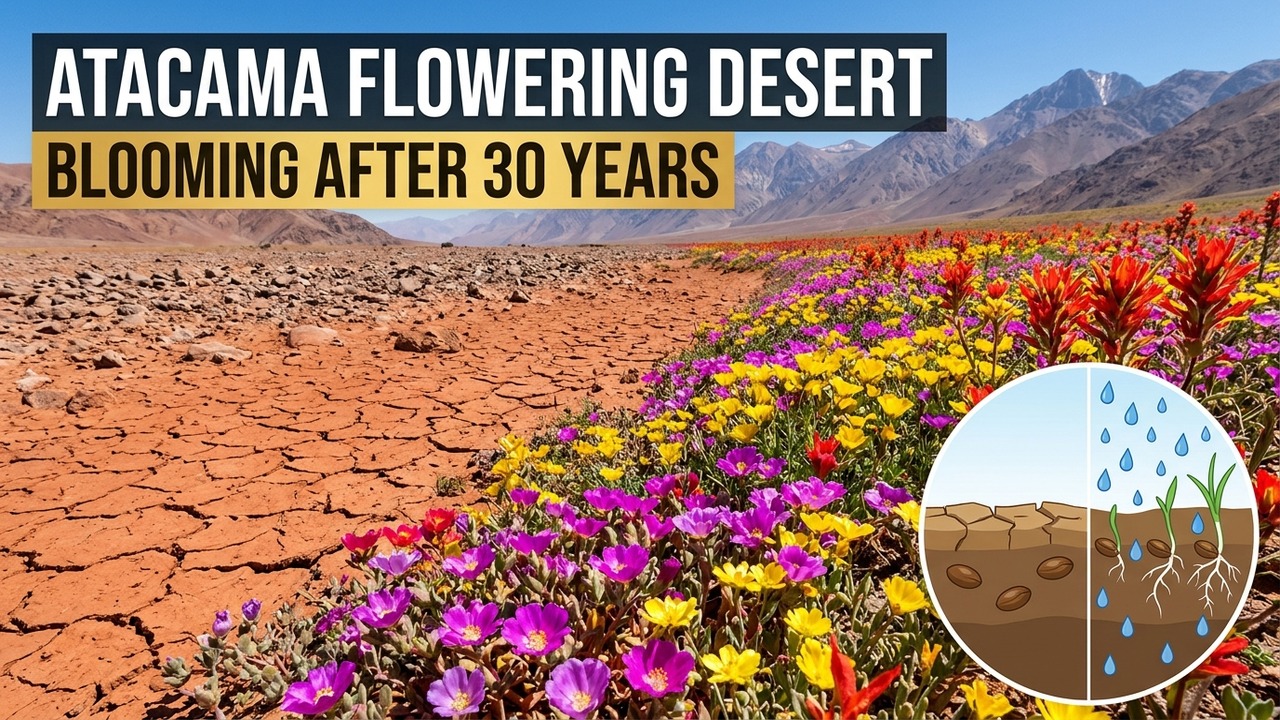
Yet, every few years, an extraordinary meteorological miracle occurs. Dark storm clouds roll in from the Pacific Ocean, dumping a rare blanket of rain over the parched landscape. Within weeks, the lifeless grey hills crack open. Across a territory larger than many small nations, the scorched desert transforms into a breathtaking, riotous ocean of magenta, purple, yellow, scarlet, and snow-white wildflowers stretching toward the horizon.
Even more astonishingly, in recent months, mountain ridges that had remained completely barren, dry, and brown for over thirty to forty years suddenly burst into full, vibrant bloom! The gray, martian-like landscape of northern Chile turned into a living tapestry of life so massive that astronauts aboard the International Space Station and NASA Earth Observatory satellites watched the desert change color from outer space.
The Blooming Desert: Science of the Atacama Super-Bloom
Our academic video documentary investigating how Humboldt Current inversions, El Niño ocean-atmosphere coupling, and 30-year subterranean seed banks orchestrate Chile's Desierto Florido will premiere right here.
This jaw-dropping natural spectacle is known throughout the scientific world as Desierto Florido (literally, the "Flowering Desert"). It takes place in northern Chile's Atacama Desert—the single driest non-polar desert in existence.
How can an environment where rainfall is measured in mere millimeters per century sustain such an explosion of living botanical beauty? Where do these seeds hide for decades without rotting or dying? And what delicate atmospheric engine triggers this grand botanical awakening? In this masterclass designed specifically for young scholars of Classes 9 and 10 preparing for the National Geography Talent Search Exam 2026, the Academic Editorial Board of Mission Geography uncovers the climatology, geomorphology, and evolutionary wonders of Earth's blooming desert.
1. The Geographic Arena: Why Is the Atacama Desert So Incredibly Dry?
To grasp why the flowering desert is such an astonishing phenomenon, one must first understand its location. The Atacama Desert is a 1,000-to-1,200-kilometer strip of coastal land stretching between the Pacific Ocean and the Andes Mountains in northern Chile, spilling slightly into southern Peru.
While the Sahara Desert in Africa is the world's largest hot desert, it is not the driest. The Atacama holds that title with absolute finality. In places like Quillagua or Yungay in the central core of the desert, weather stations have recorded an average annual rainfall of less than 1 millimeter (0.04 inches) per year! In fact, historical records show that certain weather stations in the Atacama went without a single measurable drop of rain for more than four centuries (400 years) between 1570 and 1971!
Why is the Atacama so relentlessly dry? In physical geography, this extreme condition is caused by a unique combination of three powerful geographic factors:
1. The Cold Humboldt Current
The cold Humboldt Current (also called the Peru Current) flows northward from the frigid Antarctic along the Chilean coast. This icy sea water cools the lowest layer of the maritime air. Cold air is denser than warm air, creating a persistent atmospheric temperature inversion: cool moist air is trapped at the surface beneath a layer of warm, dry air aloft. This inversion prevents convection clouds (cumulus and cumulonimbus) from forming, meaning rain clouds simply cannot develop.
2. The Double Rain Shadow
The Atacama is caught in a geographic pincer movement known as a double rain shadow. To the east, the towering Andes Mountains (reaching over 6,000 meters) completely block moisture-laden trade winds blowing from the Amazon Basin and Atlantic Ocean. To the west, the Chilean Coastal Range (Cordillera de la Costa) acts as a secondary barrier, preventing dense marine fog from penetrating into the desert interior.
3. Pacific Subtropical High
The desert sits directly beneath the South Pacific Subtropical High-Pressure Cell. In high-pressure belts, air constantly descends toward the surface (subsidence). As descending air compresses, it warms and dries out, dissipating moisture and ensuring continuous cloudless, desiccating skies year-round.
Because of this hyper-aridity, the soil in the core Atacama is essentially ancient dust, rich in nitrates, sulfates, and toxic perchlorates. It is so dry and devoid of organic matter that NASA scientists and astrobiologists use the Atacama as an analog testing ground to simulate conditions on the surface of Mars!
2. The Miracle of *Desierto Florido*: An Ancient Seed Vault
If the Atacama Desert is as dry and desolate as the surface of Mars, how could it possibly produce an ocean of flowers? The secret lies not above the surface, but deep beneath it: in a vast, subterranean repository known to botanists as an underground dormant seed bank (*banco de semillas durmientes*).
Over millions of years of evolutionary adaptation, native desert plants have evolved strategies that invert our conventional understanding of plant life. In temperate zones, a plant lives for months or years above ground, producing seeds that germinate the following spring. In the Atacama, however, plants spend 99% of their lifespan hidden as dormant seeds, bulbs, rhizomes, and tubers safely nestled several centimeters beneath the baking clay and sand!
The Armor of Dormancy: How Seeds Sleep for Decades
How does a tiny seed survive 30 or 40 years without shriveling up and dying? Atacama seeds possess ultra-thick, impermeable outer seed coats (testa) fortified with natural chemical inhibitors, most notably abscisic acid (ABA). This hormone acts as a biochemical "sleep lock," completely preventing the embryo from absorbing moisture or metabolizing cellular sugars until a substantial, prolonged saturation of water chemically dissolves and washes the inhibitor away. These dormant plants are classified as ephemerals or therophytes—plants whose entire above-ground life cycle is compressed into a rapid, furious burst lasting just a few weeks.
Alongside annual seeds are perennial geophytes: plants that store water and nutrients in subterranean bulbs and tubers (such as the native Ñañucas and Añañucas). While their leaves and stems wither away within days of a past bloom, their underground bulbs remain perfectly hydrated in a state of suspended animation, protected by the insulating soil from scorching daytime heat ($>40^\circ ext{C}$) and freezing desert nights.
3. The Atmospheric Ignition: El Niño and the 15mm Rule
The seeds are ready and waiting. But what forces the sky to finally open up over one of the most rain-starved places on Earth?
The ignition switch of the blooming desert is one of the most powerful macro-climatic phenomena on our planet: the El Niño-Southern Oscillation (ENSO).
A. How El Niño Breaks the Desert's Aridity Lock
Under normal conditions (known as Neutral or La Niña phases), strong equatorial trade winds blow westward across the Pacific Ocean, pushing warm surface water toward Indonesia and Australia. Off the coast of South America, this displacement causes deep, frigid, nutrient-rich water to well up to the surface (the Humboldt Current), reinforcing the atmospheric temperature inversion that keeps the Atacama dry.
Every two to seven years, however, the global atmospheric pressure flips. The trade winds weaken dramatically or even reverse direction. Without the wind pushing it westward, a colossal tongue of warm equatorial water—the El Niño warm pool—surges eastward toward the coasts of Peru and Chile.
The Ocean-Atmosphere Cascade: The Rain Engine
1. Sea Surface Warming: The warm El Niño waters override the cold Humboldt Current, elevating coastal sea surface temperatures by $2^\circ ext{C}$ to $5^\circ ext{C}$ above normal.
2. Destruction of the Inversion: The warm ocean warms the lower atmosphere from below. This destroys the temperature inversion layer that normally suppresses cloud formation.
3. Vigorous Convection: Intense evaporation feeds massive updrafts of warm, buoyant, moisture-laden air. Storm fronts roll off the Pacific and crash into the coastal desert, producing rare, torrential rainfall between the months of May and August (the Southern Hemisphere winter).
B. The Critical 15 Millimeter Hydrological Threshold
Interestingly, a light morning drizzle or a heavy coastal fog (*camanchaca*) will not trigger the flowering desert. Desert botanists at the Pontificia Universidad Católica de Chile and the Chilean Ministry of the Environment have discovered that the seed bank responds only to a precise hydrological threshold:
To awaken the dormant seeds, the desert must receive a minimum of approximately 15 millimeters (0.6 inches) of rainfall within a relatively short window during the late autumn or winter months. If rainfall is less than 15 mm, the moisture evaporates in the dry desert air before it can penetrate deep enough to dissolve the abscisic acid coats surrounding the seeds. But once precipitation crosses that 15 mm tipping point, moisture seeps 10 to 20 centimeters into the subsoil—and the biological timer begins ticking!
4. The 2026 Historic Super-Bloom: Awakening After 30 to 40 Years
While modest blooming events occur in small pockets of the Atacama every 5 to 10 years during moderate El Niño events, the spectacle that unfolded in 2026 shattered historical benchmarks.
Beginning in late winter, an unusually vigorous atmospheric river linked to equatorial Pacific temperature anomalies channeled intense precipitation deep into northern Chile's Atacama Region (centered between the coastal city of Caldera, Vallenar, and the outskirts of Copiapó). Certain weather stations recorded more rain in 48 hours than they normally receive in an entire decade!
A 17,000-Square-Kilometer Botanical Empire
According to botanical surveys by the Chilean Government and scientific dispatches reported by the Associated Press, the 2026 bloom expanded across more than 17,000 square kilometers (over 6,500 square miles). It stands as one of the most geographically expansive super-blooms recorded since the legendary 1997 event!
Hills Silent for Four Decades Burst Into Life
Most remarkably, remote mountain ridges and gravel plains that had remained completely barren, dry, and brown since the early 1990s—showing no plant life for 30 to 40 years—erupted into dense carpets of purple and yellow blossoms. Seeds that were shed when modern students' parents were children had survived completely intact beneath the soil, waiting for 2026 to make their appearance!
NASA Earth Observatory satellites captured breathtaking before-and-after imagery. Satellite spectral bands that normally show the Atacama as dull, uniform beige and grey suddenly registered radiant spectral shifts as massive swaths of terrain turned vivid shades of violet and green.
5. Botanical Marvels: Meet the Stars of the Bloom
The flowering desert is not a random collection of weeds. Over 200 distinct species of native wildflowers participate in this grand festival, and astonishingly, more than 60% of them are completely endemic—meaning they exist nowhere else in the natural world except northern Chile!
Among the hundreds of species, several iconic plants define the visual palette of the desert:
-
The Magenta Carpet — Cistanthe longiscapa (Pata de Guanaco / Rock Purslane):
This succulent annual is responsible for the vast, eye-popping purple and magenta plains that stretch for miles along the Pan-American Highway. Its fleshy, water-storing leaves allow it to grow in gravelly slopes, producing thousands of delicate purple flowers with brilliant golden-yellow stamens. -
The Crown Jewel — Bomarea ovallei (Garra de León / The Lion’s Claw):
Universally regarded as the holy grail of desert botanists, the *Lion's Claw* is one of the rarest, most endangered, and most spectacular plants on Earth. It grows as a low, creeping vine with clusters of enormous, velvet-textured, blood-red and crimson flowers. It is found exclusively in a tiny micro-habitat along the coastal cliffs of the Atacama, and its seeds can sleep undisturbed for decades until precise moisture conditions are met. -
The Golden Trumpets — Rhodophiala bida (Ñañucas / Añañucas):
Sprouting from deep underground bulbs, these trumpet-shaped flowers burst forth in fiery shades of canary yellow, orange, and crimson. Because they rely on pre-stored energy inside their subterranean bulbs, they are often the very first flowers to pierce the soil within days of rainfall. -
The Fragrant Bells — Nolana species (Suspiros de Campo):
Blanketing the sandy dunes near the ocean, these delicate bell-shaped flowers range from baby blue and lilac to pristine snow-white, filling the normally scentless desert air with a sweet, honey-like fragrance.
6. The Ephemeral Trophic Cascade: An Ecosystem Reborn
In physical and ecological geography, an ecosystem is never defined by plants alone. When the flowers bloom, they ignite a rapid, synchronized ecological chain reaction known as a trophic cascade.
For decades, the desert surface appeared sterile. But the moment millions of flowers open their petals, the silence is broken by a deafening hum:
1. The Pollinator Boom
Tens of millions of solitary native desert bees, hoverflies, hawkmoths, and painted lady butterflies hatch simultaneously from subterranean pupae that lay dormant in dry burrows. They feed furiously on rich nectar and pollen, ensuring cross-pollination across the desert floor.
2. The Secondary Consumers
The explosion of insects brings forth predatory arachnids (desert scorpions and solifugids) and native reptiles, such as the Microlophus atacamensis (Atacama lava lizard), which feast on the bountiful insect buffet.
3. Avian & Mammalian Nomads
Flocks of desert seed-eating finches, hummingbirds, and burrowing owls arrive from the Andean foothills. Herds of wild guanacos (wild South American camelids related to llamas) migrate into the lowlands to graze on the succulent vegetation.
For roughly 60 to 90 days, the Atacama is as lively, biodiverse, and energetically productive as any temperate meadow or savanna on Earth. It is a complete, functioning ecosystem that materializes out of thin air, runs at full throttle, and completes its entire life cycle before the desert sun returns to claim the land.
7. The Closing of the Curtain: The Return to Sleep
As spring transitions toward summer, the relentless geographic reality of the Atacama asserts itself once more. The equatorial El Niño pool dissipates. The South Pacific High reclaims the skies. The searing solar radiation dries out the upper soil horizon.
Within a few weeks, the petals wither and fall. The lush green stems turn golden brown, crumble into dust, and are swept away by the afternoon coastal breezes. To a traveler driving through the Atacama in the months following the bloom, the landscape once again looks bone-dry, rocky, and completely devoid of life.
Has life been defeated? Has the desert died once more?
Absolutely not. Before dying, every single flower produced hundreds—in some cases thousands—of microscopic seeds. Millions of new seeds, armored with thick protective coats and fresh doses of germination-inhibiting abscisic acid, have been shed into the cracks of the desert floor. Subterranean bulbs have refueled their sugar stores through weeks of photosynthesis and sealed themselves beneath the clay.
The underground seed bank is now richer, deeper, and more resilient than it was before the rain. The seeds will rest silently in the dry earth—whether for five years, ten years, or another thirty years—waiting patiently for the next El Niño sky to call them back to life.
8. Astrobiology: What the Atacama Teaches Us About Mars
For students of planetary geography, the Atacama super-bloom is more than just a beautiful terrestrial event: it is a profound lesson in how life can survive on other worlds in our solar system.
The soils of the Atacama Desert are chemically very similar to the regolith found in Gale Crater or Jezero Crater on Mars: dry, bombarded by intense ultraviolet radiation, and laden with perchlorates. For years, scientists debated whether living organisms could survive in such hyper-arid, chemically hostile soil.
The Atacama proves that biology is exceptionally patient. Microorganisms and plant seeds do not need continuous moisture to survive. By entering a state of cryptobiosis or metabolic dormancy, biological structures can remain viable across decades of harsh desiccation. If microbial life ever evolved on Mars during its ancient, wetter past ($>3.5 ext{ billion years ago}$), the lessons of the Atacama suggest that viable spores or biological signatures could still be preserved, sleeping quietly beneath the martian dust, waiting for moisture that may never come.
9. Masterclass Quiz: Test Your Conceptual Understanding
Challenge yourself with these high-yield physical geography and climatology questions designed for the National Geography Talent Search Exam:
Q1: Why does the cold Humboldt Current prevent rainfall over the coastal Atacama Desert instead of promoting it?
Answer: The cold sea water cools the lowest layer of marine air, making it denser than the warm air above it. This creates a persistent temperature inversion, which prevents vertical convection. Without vertical rising air, towering rain clouds (cumulonimbus) cannot form, resulting in dense sea fog (*camanchaca*) without true rainfall.
Q2: Why does light drizzle fail to trigger the Desierto Florido, and what is the scientific significance of the "15 mm threshold"?
Answer: Atacama seeds are protected by thick coats and chemical germination inhibitors (abscisic acid). Light rain evaporates in the hyper-arid air before reaching the seed horizon. A minimum of ~15 mm of rain is required to soak 10–20 cm deep into the subsoil, chemically dissolving the germination inhibitors and waking the embryo.
Q3: How does the oceanic phenomenon of El Niño reverse the desert's rainfall deficit?
Answer: During El Niño, weakening trade winds allow warm equatorial waters to flow eastward along the Chilean coast, overriding the cold Humboldt Current. This warms the surface air, destroys the coastal temperature inversion, and triggers powerful convection storms that dump torrential rain onto the desert.
10. Conclusion: The Undying Heart of Our Living Planet
When you look at a photograph of the Atacama Desert before the rains, it is easy to see only death, dryness, and barren stone. Human intuition tells us that without water, life cannot exist.
Yet, the phenomenon of *Desierto Florido* offers us one of the most powerful and inspiring truths in the study of Earth sciences: life does not give up easily. It adapts. It endures. And sometimes, it simply knows how to wait.
Beneath the driest soil on our planet, life built an underground library of sleeping beauty that waited out thirty years of silence. And when the right moment arrived, it proved to the entire world that nature's greatest masterpieces are often hidden in plain sight, waiting for the curious minds of young geographers to understand and appreciate them.